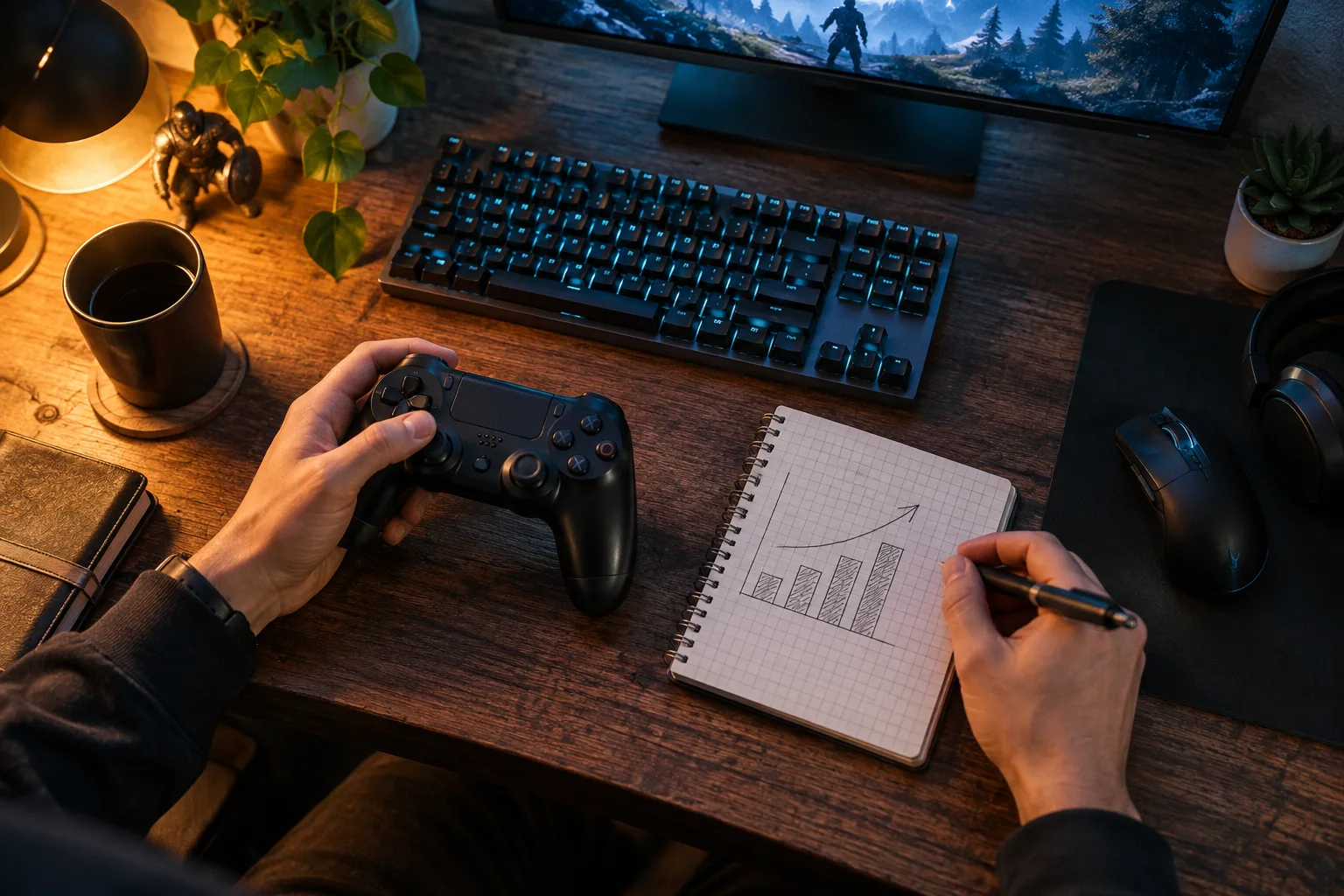
Game settings without the chaos: compare one change at a time
Choose a repeatable sequence and record not only FPS but also noticeable delays and image quality.
Read storyCompare the same scenes, watch for frame-time spikes and change one setting at a time instead of chasing a single average.
A high counter can coexist with visibly uneven movement. An average frame rate may hide individual delays. A repeatable test tells you more than a screenshot of the highest number you managed to reach.
FPS counts frames per second. At an even 60 FPS, each frame takes about 16.7 milliseconds; at 120 FPS, about 8.3. An average does not mean every frame arrives at the same interval.
If your monitoring tool offers a frame-time graph, look for spikes when the hitch occurs. With frame generation enabled, also check what the counter measures. Valve describes separating rendered and generated frames in its performance monitor. Steam’s Performance Monitor material.
Choose a short repeatable route or a built-in benchmark. Keep the resolution, scene and background applications consistent. Record settings and observations. Comparing a quiet menu with a busy fight tells you little about the effect of a change.
Note whether the issue appears immediately or only after some time. A single component-utilisation reading is a clue, not a complete diagnosis.
Save the original configuration. Adjust one setting and repeat the route. Consider image quality, control response and visible hitches as well as the numbers. Revert the change if it makes the experience worse.
Do not buy replacement hardware because one random measurement was disappointing. First establish which game and conditions reproduce the problem.
The objective is a useful balance of image quality and control, not a counter record. Record a successful setup so you do not restart the experiment after every update.
The same principle applies to websites: specific interactions matter more than a single overall score. Read our guide to diagnosing a slow website.
Continue the topic and work through the next step.
Choose a repeatable sequence and record not only FPS but also noticeable delays and image quality.
Read story